
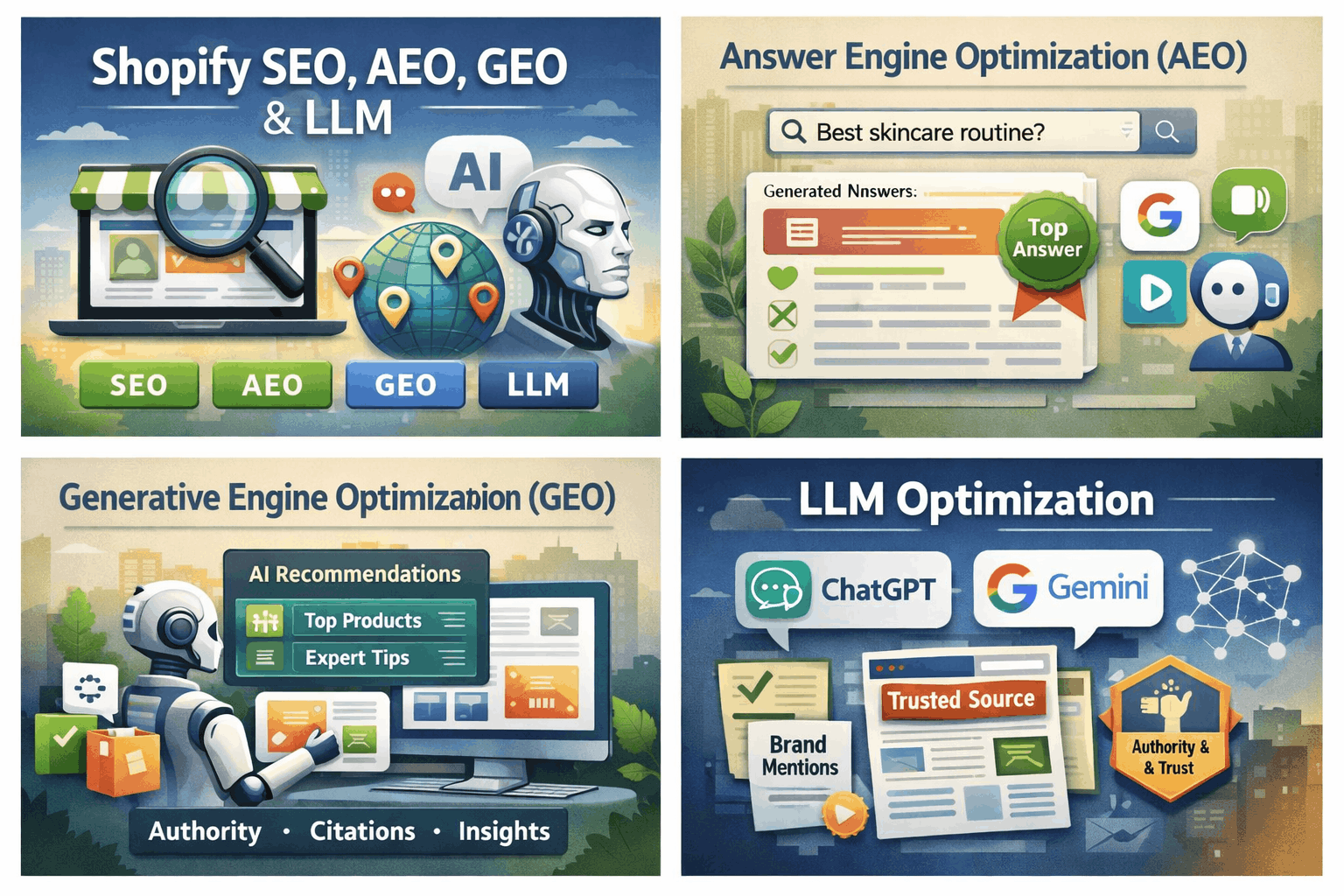
Shopify SEO, AEO, GEO and LLM
The way people discover Shopify stores has changed forever. Traditional Google search is no longer the only gateway to online visibility. Today, customers ask questions directly to AI tools, voice assistants, and generative search engines. This shift makes Shopify SEO, AEO, GEO and LLM optimization not just helpful—but essential.
If you want your Shopify store to stay competitive, you must optimize not only for search engines, but also for answer engines, generative AI, and large language models (LLMs). This guide explains how all four work together and how Shopify merchants can use them to drive sustainable traffic, trust, and sales.
Understanding the Evolution of Search for Shopify Stores
From Traditional SEO to AI-Driven Discovery
Search began with blue links and keywords. Then came featured snippets, voice search, and now AI-generated answers. Platforms like Google SGE, ChatGPT, Bing Copilot, and Gemini no longer just rank pages—they summarize, recommend, and cite sources.
This means your Shopify store may never be clicked if your content is not chosen as a trusted answer.
Why Shopify Merchants Must Adapt Now
Shopify is one of the most competitive eCommerce platforms in the world. Thousands of stores sell similar products. Optimizing only for keywords is no longer enough. Shopify brands that win today are the ones that provide clear answers, structured knowledge, and authoritative content that AI systems trust.
What Is Shopify SEO and Why It Still Matters
Shopify SEO is the foundation of all visibility. Without strong SEO, AEO, GEO, and LLM optimization cannot work effectively.
On-Page SEO Essentials for Shopify
Product titles, meta descriptions, headers, and internal links must be clean, descriptive, and user-focused.
Product Pages, Collections, and URLs
-
Use descriptive product names
-
Optimize collection pages with category-level content
-
Avoid duplicate URLs and unnecessary parameters
-
Write human-friendly descriptions instead of keyword stuffing
Technical SEO Foundations in Shopify
Site Speed, Mobile Optimization, and Indexing
Shopify stores must load fast, especially on mobile. Compress images, reduce apps, and use a lightweight theme. Make sure your store is indexable and your sitemap is submitted to Google Search Console.
AEO Explained: Answer Engine Optimization for Shopify
Answer Engine Optimization focuses on how your content answers questions directly.
How Google, Bing, and AI Answer Engines Work
Answer engines look for:
-
Clear questions and concise answers
-
Structured formatting
-
High topical relevance
-
Trustworthy sources
Optimizing Shopify Content for Featured Snippets
To rank as an answer:
-
Add FAQ sections to product and collection pages
-
Use question-based headings
-
Answer in 40–60 words when possible
-
Use lists and tables for clarity
GEO: Generative Engine Optimization for AI Platforms
What Is GEO and How It Impacts Shopify Visibility
Generative Engine Optimization helps AI tools learn from your content. When AI generates buying advice or product comparisons, it pulls from authoritative Shopify sites with strong GEO signals.
Structuring Content for AI Citations
-
Write educational blog posts, not just sales copy
-
Cover topics deeply and clearly
-
Use natural language and complete explanations
-
Build topical authority around your niche
For example, a skincare Shopify store should publish guides on ingredients, routines, and skin types—not only product pages.
LLM Optimization: Ranking Inside AI Models
How LLMs Like ChatGPT and Gemini Choose Sources
LLMs rely on:
-
Brand mentions across the web
-
Consistent expertise signals
-
Structured data
-
Clear, accurate explanations
Trust Signals, Brand Mentions, and Authority
To improve LLM visibility:
-
Earn backlinks from reputable sites
-
Publish original research or expert insights
-
Maintain consistent brand information
-
Build an “About Us” page with real credentials
High-quality content increases the chance that AI tools will reference your Shopify store as a trusted source. Learn more about structured data best practices from Google’s official documentation
Content Strategy That Unifies SEO, AEO, GEO, and LLM
A winning Shopify content strategy connects all four systems.
Blog Content, Product Education, and FAQs
Your Shopify blog should:
-
Answer buyer questions
-
Explain product use cases
-
Compare alternatives honestly
-
Include FAQs based on real customer queries
Educational content builds authority and feeds AI systems with reliable knowledge.
Technical & Schema Enhancements for Shopify
Structured Data and Knowledge Graph Signals
Add schema markup for:
-
Products
-
FAQs
-
Reviews
-
Organization details
Schema helps search engines and AI models understand your store better, increasing your chances of being selected as an answer or citation.
Common Mistakes Shopify Stores Must Avoid
-
Relying only on keywords
-
Thin product descriptions
-
Ignoring FAQs and educational content
-
Overusing AI-generated content without editing
-
Neglecting brand authority and trust
FAQs About Shopify SEO, AEO, GEO and LLM
1. Is Shopify SEO still important in the age of AI?
Yes. Shopify SEO is the foundation that supports AEO, GEO, and LLM visibility.
2. What is the biggest difference between SEO and AEO?
SEO ranks pages, while AEO focuses on answering questions directly.
3. Can Shopify stores appear in ChatGPT answers?
Yes, if they build authority, clear content, and strong GEO and LLM signals.
4. Do I need technical skills to optimize for GEO?
No. Clear writing, structured content, and consistent publishing go a long way.
5. How long does it take to see results?
SEO may take months, but AEO and GEO improvements can show faster visibility gains.
6. Is AI-generated content safe for Shopify SEO?
Yes, when edited, accurate, and written to help users—not manipulate rankings.
Conclusion: Future-Proofing Shopify Growth
The future of eCommerce visibility belongs to brands that adapt early. By mastering Shopify SEO, AEO, GEO and LLM, you position your store not only to rank—but to be recommended, cited, and trusted by AI-powered search systems.


